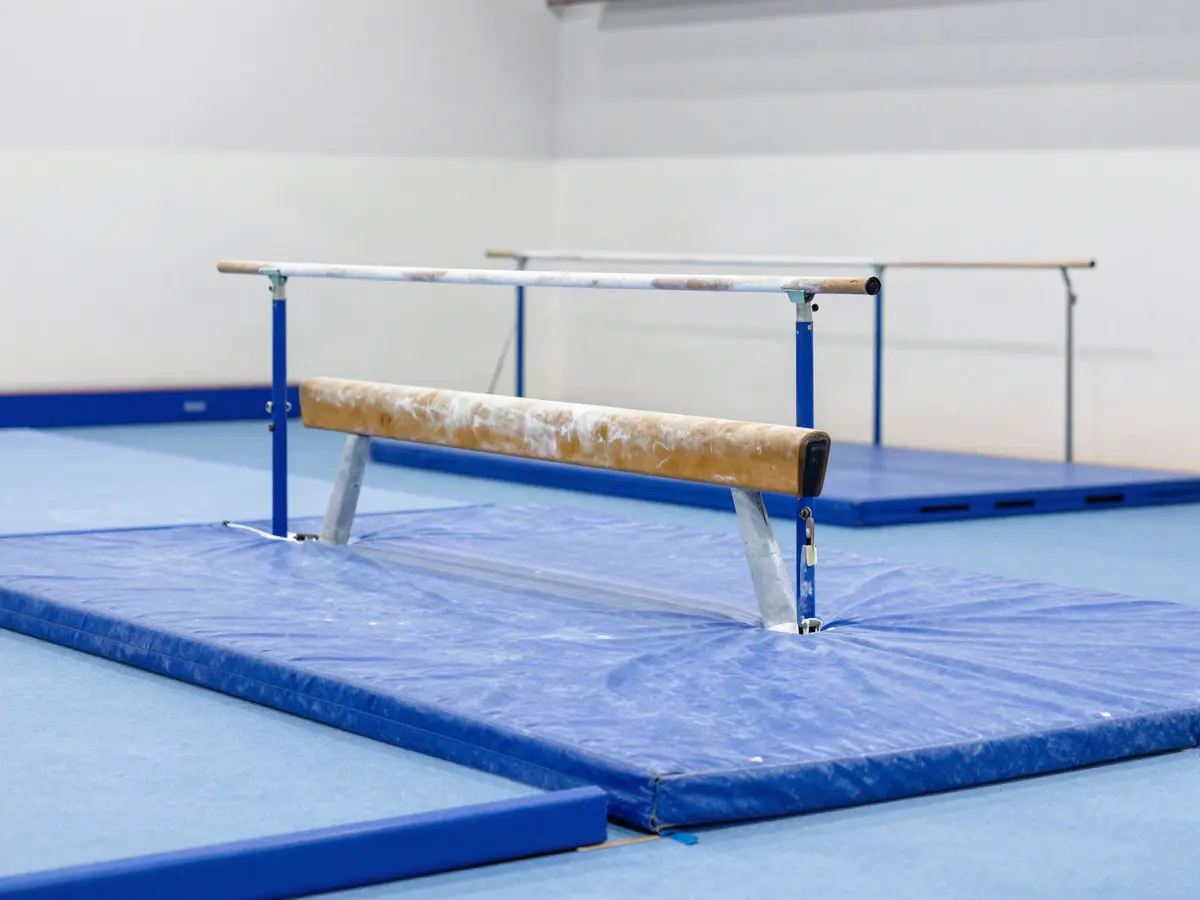
Bars, beam, vault and floor are the four competitive events. The tumble track, foam pit and spring floor exist for one reason: so a skill gets learned before it is ever tried on hard ground.
Bars: Uneven bars for swing, grip strength, and release timing, spotted closely at every level below team.
Beam: A four-inch practice beam at floor height for beginners, raised only once balance on the low beam is automatic.
Vault: A padded vaulting table with a soft, lowered run for younger gymnasts before the full runway is introduced.
Floor: A sprung competition floor for tumbling passes, rolls, and the routines that tie a level together.
Tumble track: A springy runway that exaggerates height and hang time, so a new tumbling skill can be felt correctly before it is attempted at full speed.
Foam pit: A pit of loose foam blocks for landing skills like the back handspring long before they are safe on a hard floor.
Spring floor: The same sprung floor used in competition, so what is learned in practice behaves the same way on the real thing.
Recreational classes are grouped by what a gymnast can already do, in this order. Timelines are honest ranges, not promises - "when will she get her back handspring" is the question we hear most, and this is the real answer.
1. Forward roll - Most gymnasts land this within the first month
2. Cartwheel - Typically three to six months of weekly classes
3. Bridge kickover - Usually six months to a year, once shoulder flexibility catches up
4. Back handspring - Often a year or more, taught first in the foam pit and on the tumble track before it ever touches the spring floor
Team is either invite-only or by open tryout, evaluated on all four events. It is levelled, and hours-per-week step up sharply as a gymnast moves up a level - a Level 3 gymnast might train four hours a week, a Level 7 gymnast well over twelve.
Meet season runs through the school year, with a handful of local and regional meets per level. Most of our gymnasts are recreational and always will be, and that is completely fine - the team is one path here, not the point of the gym.
Every coach is certified in spotting and progression teaching. Skills are never skipped ahead of the step that makes them safe - a back handspring is not attempted on the spring floor until it is automatic in the foam pit. Class sizes are capped so every gymnast gets hands-on spotting, not just a watching coach.
Open gym runs most weekends, school-holiday clinics fill the days off, and birthday parties use the foam pit and tumble track on Saturday afternoons - the side of the business that fills the building when classes are not in session.