Classrooms are mixed-age on purpose, spanning a three-year cycle: primary from roughly three to six, lower elementary from six to nine. A child is the youngest in the room, then the middle, then the oldest who teaches - three different roles across three years, never a single-age classroom sorted by birth year. Consolidating knowledge by teaching a younger child is not a side effect of mixed ages, it is the reason for them.
Each morning holds a single uninterrupted work period, roughly three hours long, with no bell dividing it into subjects. Children choose their own work and follow it as long as concentration holds. This is the most counter-cultural thing we do, and we do it with confidence: deep concentration cannot form if it is cut off every forty minutes.
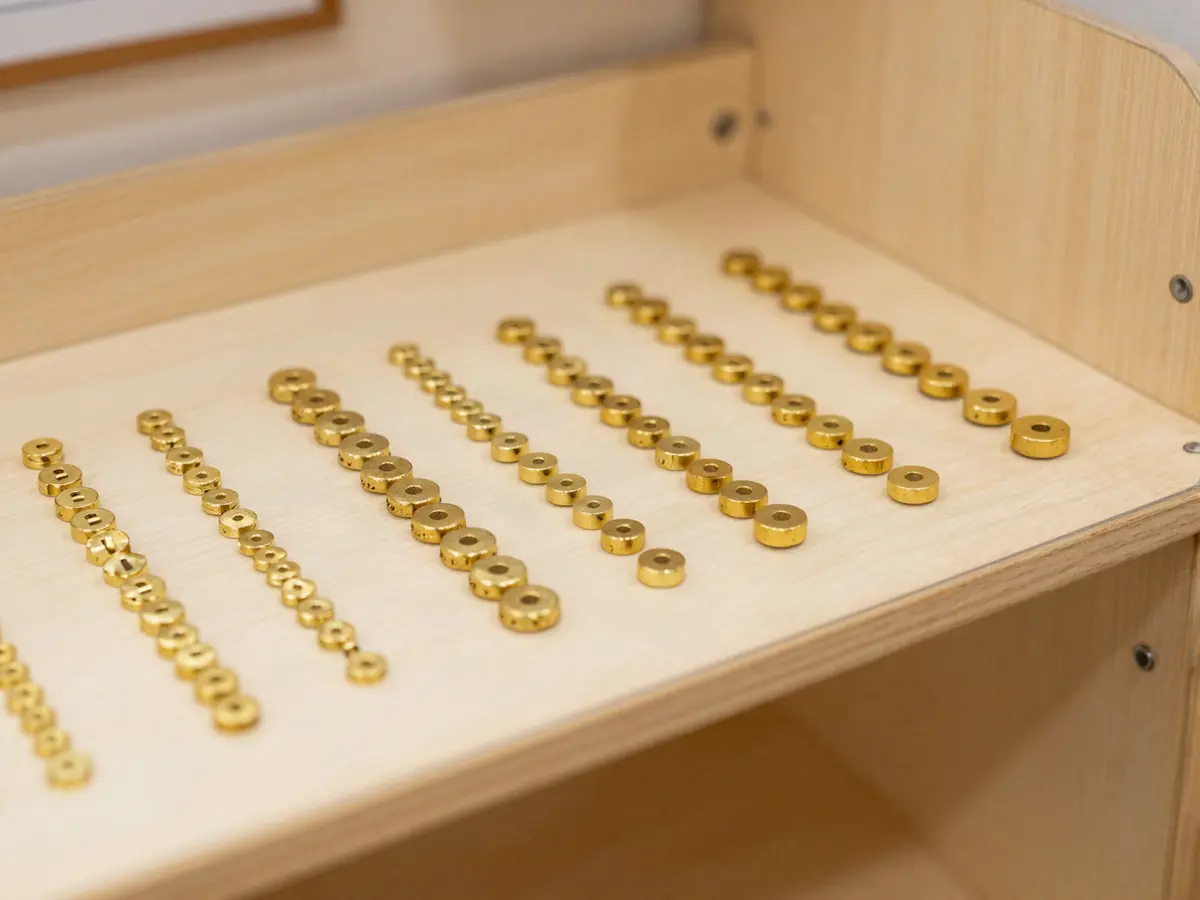
The materials are real, not toys: glass and ceramic where a daycare would use plastic, each one isolating a single concept and self-correcting, so the material itself tells a child they have made an error, not the adult. You will see the pink tower, the brown stair, the golden beads that make the decimal system physical, the moveable alphabet, and sandpaper letters traced by fingertip before they are ever written by hand. Practical life work - pouring, sweeping, buttoning, preparing food - is not a chore break. It is academic preparation: the same care and sequence a child brings to buttoning a coat is the care they later bring to a math problem.
The adult in the room is a guide, not a teacher: trained and credentialed through a recognized route, AMI or AMS, who observes closely and gives lessons to one child or a small group rather than instructing the whole room at once. There are no grades, no gold stars, and no punishments, because motivation is meant to stay internal - a child returns to a material because the work itself satisfies something, not because an adult is handing out approval. We do not assign homework and we do not give rewards, and we know that is exactly what a visiting parent is startled by the first time they see it.
The questions every visiting parent asks
Is it too unstructured? No - it is freedom within clearly held limits. A child may choose any material on the shelf, but only one at a time, used the way it was shown, and returned before another is taken. The structure is real; it is simply not a schedule imposed from outside.
Will they manage in a conventional school afterward? Children who complete a full three-year cycle tend to arrive with something a conventional school does not usually teach directly: the ability to direct their own attention and finish what they start, because that is the only way this classroom has ever asked them to work.
What about a child who needs more direction? A guide gives more frequent individual lessons and holds a narrower set of choices for a child who needs it, rather than moving the whole room to instruction. The freedom is calibrated to the child in front of the guide, not handed out equally regardless of need.