Every cemetery sets its own rules on size, height, material, color, and whether an upright stone is allowed at all - many newer sections permit only flat markers set level with the ground so mowers can pass over. We check the rules for your specific cemetery and section before we design anything, and we handle the approval submission on your behalf.
Granite comes quarried in colors from grey through black to red and mahogany, and it is chosen over marble for outdoor work because it resists weathering for far longer. A face can be polished to a mirror shine, honed to a soft matte, or left rock-pitched for a rougher, quarried texture - often combined on a single stone.
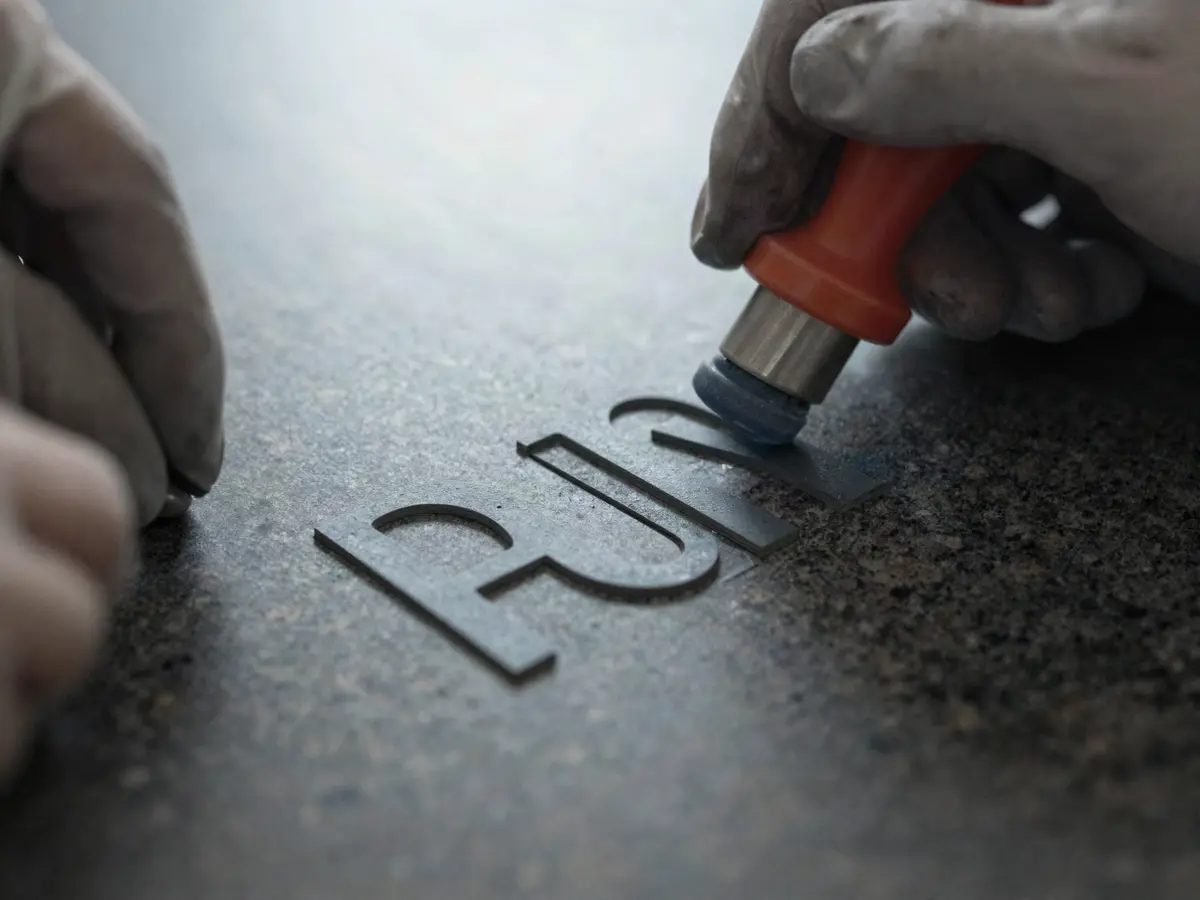
The lettering is the actual craft. A rubber stencil is cut and applied to the stone, which is then sandblasted so the letters are cut into the granite and will still be legible in a century. Laser etching sits shallow on a polished surface and gives fine photographic detail, but it is not the same process, and we will tell you plainly which suits your stone.
A carved mistake cannot be undone, so nothing is cut until a scaled drawing showing the exact wording, spelling, dates and layout is approved in writing. We would rather send a proof back for a second look than rush a stone that stays wrong for a century.
A companion stone is usually set with one person’s dates carved and the partner’s name already in place, waiting. Years later, we return to the cemetery and add the closing date. We handle this plainly, because it is simply part of the work.
Every monument sits on a concrete foundation poured to the cemetery’s specification, so the stone does not settle or lean over time. We also restore older stones - cleaning weathered granite properly, resetting a leaning monument, and re-cutting an inscription that has worn past legibility.