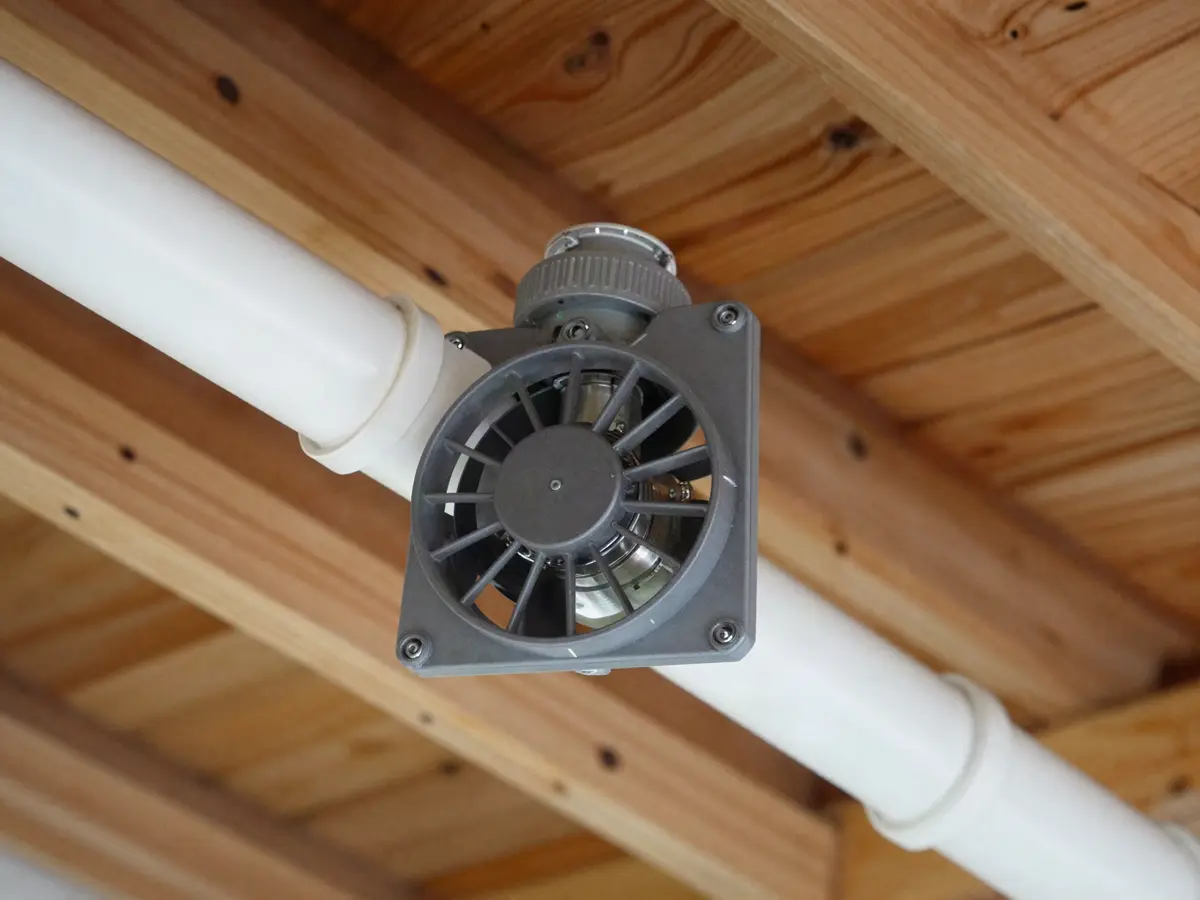
A suction point is cut through the slab down to the soil beneath it. A sealed pipe runs from that point up through the house and out above the roofline, where a continuously running inline fan pulls air from under the foundation.
That fan holds the soil beneath the house at a slightly lower air pressure than the living space above it, so soil gas is drawn out and vented above the roof instead of finding its way up through slab cracks and gaps. It is not a filter and it does not treat the air inside your rooms - it keeps the gas from entering in the first place.
The system depends on what is under the house
A poured slab foundation gets a single suction point in most cases, placed where the soil beneath it is most open to airflow. A crawl space needs a heavy sealed membrane laid across the entire dirt floor first, taped and fastened at every edge and penetration, before the same depressurization principle can pull air from beneath it.
A sump pit already gives soil gas a path into the basement, so it often gets sealed with a airtight lid and tied directly into the suction pipe rather than treated as a separate opening. A house with multiple foundation sections poured at different times - an addition, a split level - may need more than one suction point to depressurize both sides evenly.
Proof is the product
Every system we install carries a manometer - a small U-tube gauge mounted on the pipe that shows suction is present at a glance, no tools or app required. If the fan ever stops, the gauge shows it before a re-test would.
Installation is not the finish line. We run a post-mitigation test after the system has settled in, and we hand you the before-and-after numbers directly - a mitigator who does not re-test has not finished the job, they have only installed equipment and hoped.
What the system actually needs from you
The fan runs continuously, uses roughly as much electricity as a light left on, and hums faintly - most homeowners stop noticing it within days. It has a service life like any motor and is a straightforward swap when it eventually wears out. Beyond that, there is no filter to change and no routine maintenance; the manometer is how you would know if anything needed attention at all.